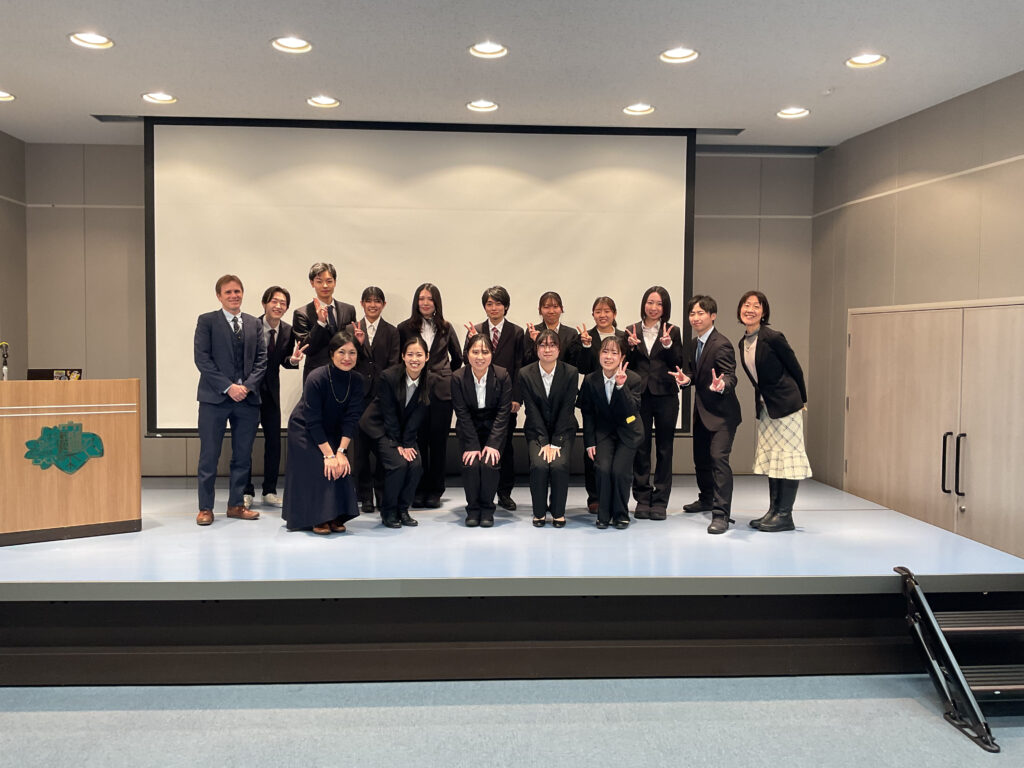
Order of Speakers
| 氏名 | 時間の目安 | |
| 1 | Yuna S | 13:05- |
| 2 | Risa T | 13:20- |
| 3 | Ami H | 13:35- |
| 4 | Momoka N | 13:50- |
| 5 | Aoka F | 14:05- |
| 6 | Yuiko O | 14:20- |
| 7 | Hiroki O | 14:45- |
| 8 | Sora K | 15:00- |
| 9 | Miyuki K | 15:15- |
| 10 | Yura K | 15:30- |
| 11 | Hiroki S | 15:45- |
| 12 | Tamawo T | 16:00- |
| 13 | Hiroyuki N | 16:15- |
| 14 | Kai K |
Download the file here:
Titles and summaries
The summaries were written by third-year members of the English Department.
Yuna S
A Study of the Depiction of American Frontier in the Toy Story Series and its Effects
In this study, she considered another American history and what the story was trying to convey, through the dialogue and descriptions in the story. Woody and Buzz Lightyear, who appear in this story, represent the western frontier(People who were driven west) and the space frontier(Apollo Project and the Dream of Space). In the Toy Story series, the popularity of toys shifts from Woody to Buzz Lightyear. This represents a changing era in America. In this story, they never return to their original owner. This is not only a connection of two frontiers, It depicts the future of America as it explores new frontiers. Also, this story makes you think about what kind of future awaits when these two frontiers connect.
Risa T
The Potential of Generative AI in Elementary School English Education
This study explores the potential of generative AI in elementary school English education in Japan through a literature review. The results show clear research biases: most studies focus on university-level learners, mainly examine speaking and writing skills, and primarily target conversational AI tools such as ChatGPT.
In contrast, empirical research in elementary school contexts is still limited, and studies on listening, reading, and other types of generative AI remain scarce. The study suggests that generative AI should be used as a supportive tool within teacher-guided, textbook-based lessons rather than replacing teachers. Future classroom-based research is needed to identify effective ways to integrate generative AI into elementary school English education.
Ami H
The Picture of Dorian Gray in the Age of SNS: “Gaze of the other” and portraiture
In her presentation, she analyzes Oscar Wilde’s The Picture of Dorian Gray from the perspective of the “gaze of others.” Dorian’s tragedy lies in the fact that the outer self-created by others’ gaze becomes the basis of his actions, causing him to lose his inner judgment.
She concludes that this structure also applies to today’s SNS society, where self-images shaped by others’ evaluations inflate the outer self and widen the gap between the outer and inner selves.
Momoka N
Charlie and the Chocolate Factory: The Reason Why Charlie Was Chosen as the Successor
In her presentation, she examined why Charlie was chosen as the successor based on Willy Wonka’s remarks and an analysis of the characters’ personalities.
She concludes that Charlie was chosen as the successor because he possessed the qualities Willy Wonka valued from the beginning. Wonka sought a “sensible and loving child,” and while the other children were eliminated, Charlie showed patience, kindness, and humility.
Aoka F
The attitude toward our solitude through Escape Routes
The purpose of this research was to examine how solitude is portrayed in “Nigemichi” by Naomi Ishiguro and to consider its influence on the characters. She focused on the experiences of both adult and child protagonists. Adult characters experience solitude even while living with family members or partners, which leads them to reflect on themselves and become aware of others’ feelings. In contrast, child characters face solitude while being alone, and this solitude helps them develop independent thinking and creativity. In conclusion, she argues that solitude in “Nigemichi” is not always negative, but can become an opportunity for personal growth, reflection, and the improvement of human relationships.
Yuiko O
An Analysis of Communicative Purposes, Scenes, and Situations in Language Activities of Junior High School English Textbooks
This research examined how language activities in junior high school English textbooks are designed in terms of their purposes, scenes, and communication partners. Four different textbooks were analyzed to identify what kinds of communicative activities are commonly used. The analysis showed that many activities are set in familiar and easy-to-imagine context, such as school life and conversations with friends or classmates. These settings help reduce students’ anxiety and encourage them to use English more opportunities to experience a wider variety of communication situations. This research suggests that while familiar contexts are important, it is also necessary to gradually include more diverse and communication partners in language activities.
Hiroki
The Effect of AI-Generated Speech on Shadowing Accuracy
This study examined whether AI-generated speech based on learners’ own voices improves shadowing accuracy compared with native-speaker audio. Five Japanese university students recorded sentences under three conditions: reading aloud, shadowing native audio, and shadowing AI-generated “golden speech.” Pronunciation accuracy was measured using Word Error Rate (WER). Results showed that both shadowing conditions increased WER compared with reading aloud, indicating no short-term improvement. However, AI shadowing produced lower WER than native shadowing, suggesting that AI-generated speech may be easier to imitate because it is slower and closer to the learner’s own voice.
Sora K
On the Unreliable Narration in Never Let Me Go
Cathy’s unreliable narratives are thought to stem from two factors: vague memories and differences in interpretation. Furthermore, because negative comments increase as death approaches and decrease as she accepts it, it is thought that the proportion of unreliable narratives changes as Cathy’s feelings change
Miyuki K
A Study of Japanese Onomatopoeia, in Night Train to the Stars: A Contrastive Analysis of the Japanese Original and the English Translation
This study examined onomatopoeia in Night Train to the Stars. She looked up all onomatopoeia in Japanese and English.
As a result, first, one onomatopoeia was translated to a lot of meaning in English. Second, translators may have selected and trashed in order to be read easily for people in English. Third, Japanese onomatopoeia tends to express subtle nuances of sound, while English focuses more on conveying meaning. Fourth, it is difficult to completely translate Japanese onomatopoeia into English.
Yuura K
The Correlation Between Foreign Language Anxiety and Self-Esteem in University Students
This study examined Anxiety and self-esteem between English majors and non-English major students using two scales, FLCAS and RSES. Self-efficacy is significantly related to anxiety. Cultivating self-efficacy requires accumulating successful experiences. It is crucial for students to reduce anxiety,and for teachers, it is also important to conduct more effective English classes by thinking about these points, which they searched for.
Hiroki S
The Role of Foreign Language Education in Student Guidance at University
This research examined whether foreign language education is effective in student guidance at university. We had classmates with the exception of university. Then he took a questionnaire about how foreign language education in university affects your well-being, for Iwate university students(1 grade~4 grade).
As a result, they became more motivated to study linguistics. Also, they could make a good relationship with their friends and get mental stability. Through this questionnaire, we understood that foreign language education in university has a good effect on students.
Tamawo T
Henry’s Vision of an Ideal Couple in “The Gift of the Magi”
This study looks at O. Henry’s idea of an ideal couple in “The Gift of the Magi.”
She analyzes the story, O. Henry’s real life, the social background of the time, and other works by O. Henry.
The narrator calls the couple “Magi,” so the study says O. Henry shows them as a good and ideal couple.
The study also focuses on Della. It suggests that Della may be based on O. Henry’s wife, Athol, because they have similar traits such as kindness and sacrifice.The study also checks gender roles. At that time, men and women had strong social roles, but this story does not completely follow them.
By comparing other stories, the study finds four important points for an ideal couple: being independent, understanding each other well, having a mutual relationship, and being honest.
Finally, the study concludes that deep love is the main reason why people are willing to sacrifice for their partner.
Hiroyuki N
An Analysis of English Textbooks in Japanese Junior High Schools: Balancing the Five Skill Areas and Considering the Elementary–Junior High School Connection
This study examined the distribution of skills in the language activities in junior high school English textbooks to consider how integrated these textbooks are with elementary school English. It focused on the previous and current Grade 1 New Horizon and Sunshine textbooks. It concluded that while elementary school textbooks had task-like speaking activities, the JHS textbook had proportionally fewer of such activities. To better connect elementary school and junior high school English, Nezawa argued that teachers will need to supplement the textbook with task-like activities.
Kai K
Changes in Students’ Intercultural Competence: Focusing on Relationship-Building in an International Collaborative Learning Course
This study examined how students develop intercultural competence (IC) in an international collaborative learning course. While overall IC scores increased significantly, about 40% of students showed only small numerical changes. Qualitative analysis revealed that these students still engaged in meaningful learning processes, including coordinating opinions, mediating cultural differences, experiencing anxiety and conflict, and reflecting on stereotypes. These challenges led to gradual shifts in perspective. The findings suggest that IC develops non-linearly and cannot be fully captured by short-term score changes. Effective evaluation should consider learning processes, and classes should provide safe spaces for struggle, reflection, and interpersonal growth
This is a very original topic! You provide a new perspective on the movie, and it will change the way I look at Buzz Lightyear and Woody. I was wondering if there was some previous research on the culture behind Toy Story. Have any other writers had similar ideas?
Also, is there any evidence that the makers of this movie had these concepts in mind when they created it?
I thought your findings on the research of AI were particularly useful. You have indeified where AI research lacks, and as an elementary school teacher, you have a chance to fill in these gaps!
I listened to this book on audio last year. I primarily listened to it while jogging. I remember just being completely disgusted by the character of Dorian Gray. I have never been so disgusted by a book character before. Now, though, I have a new perspective on the story thanks to you. Your message that the gap between external and internal appearance that Dorian Gray had can be equated with our profiles on SNS was very powerful. Maybe its time to rethink how we show ourselves on SNS.
I first read this book when I was in elementary school. Your presentation made me think about why a character like Charlie is so admirable. Do you think Charlie has the kind of strengths that will make people successful in this modern age? Would Charlie be the ideal image of a child that people from Iwate have?
“Solitude” is an interesting theme. It is interesting how you reveal various aspects of solitude through the stories. I guess we all need balance in life. Sometimes we need to be around other people, and sometimes we need to be alone.
You clarify some very tricky Course of Study concepts and show how they are applied in the textbooks. This is very useful for those who will be teaching. The other day, a student in 英語科教育法(小) asked me, “What is the difference between scene and situation?”
I don’t think anybody makes slodes as well as you do! You make the procedures very clear. I think that shadowing is extremely important for learning English. One of the components of language aptitude is phonemic coding ability; shadowing can arguably enhance this type of ability.
I have a question. Does the Golden voice sound authentic? If it does not, then I think listening to a native speaker might be better practice even though it is more difficult.
Sora,
I listened to the audiobook version of this story. It was very powerful to actually HEAR the narrator tell the story. I never really considered the reliability of the narrator, but your conclusion that the reliability of the narrator changes as she recognizes the reality of her own demise.
It is great that you chose an author from Iwate. Good selection of material to analyze!
It is interesting to me that they put onomatopoeia into English words rather than use sounds. It makes sense to me, though, because a lot of onomatopoeia describes actions that have no sounds!
Upon reflection, I believe that you could likely find a strong correlation between FLA and self-efficacy because the latter is more content-specific.
I think that this research has a strong message for teachers. That is, when a learner feels anxiety in the English class, it is not necessarily connected with self-esteem. Therefore, if we improve class conditions, their anxiety will likely decrease!
I agree with you that English class is good in helping students establish interpersonal relationships. It is useful for me to know what expectations university students might have for guidance.
What makes a good couple? I think a lot of English Department members might have unexpectedly picked up some life wisdom from our presentation!
I thought you convincingly pointed out the characteristics of the JHS textbooks and their weaknesses. You also proposed what teachers should do to overcome these limitations. I believe that your research would be good for textbook publishers to see.